
Product
|
A Backend for Everyone on Your Team
Directus now includes native draft and publishing workflows, a redesigned Studio, AI-assisted translations, JSON filtering, and OAuth 2.1 for MCP.

James White
Head of Product
Directus has always been the collaborative backend. Developers choose it for its API flexibility, database-first architecture, and ground control.
But building an application takes a whole team, not just the technical half. With this release, we've invested heavily in making the Studio experience even better for business teams, too.
Now, Directus is truly a shared workspace that works perfectly for the people who build the backend and the teams who use it every day.
What's New
Directus v12 has native editorial workflows, AI-assisted translations, a redesigned Studio for non-technical users, and enterprise-grade authentication for AI-connected workflows. This release also includes a licensing transition to make our terms simpler, more predictable, and easier for everyone to understand.
Every major change maps back to the same question: does this make Directus work for entire teams of builders?
Native Draft and Publishing
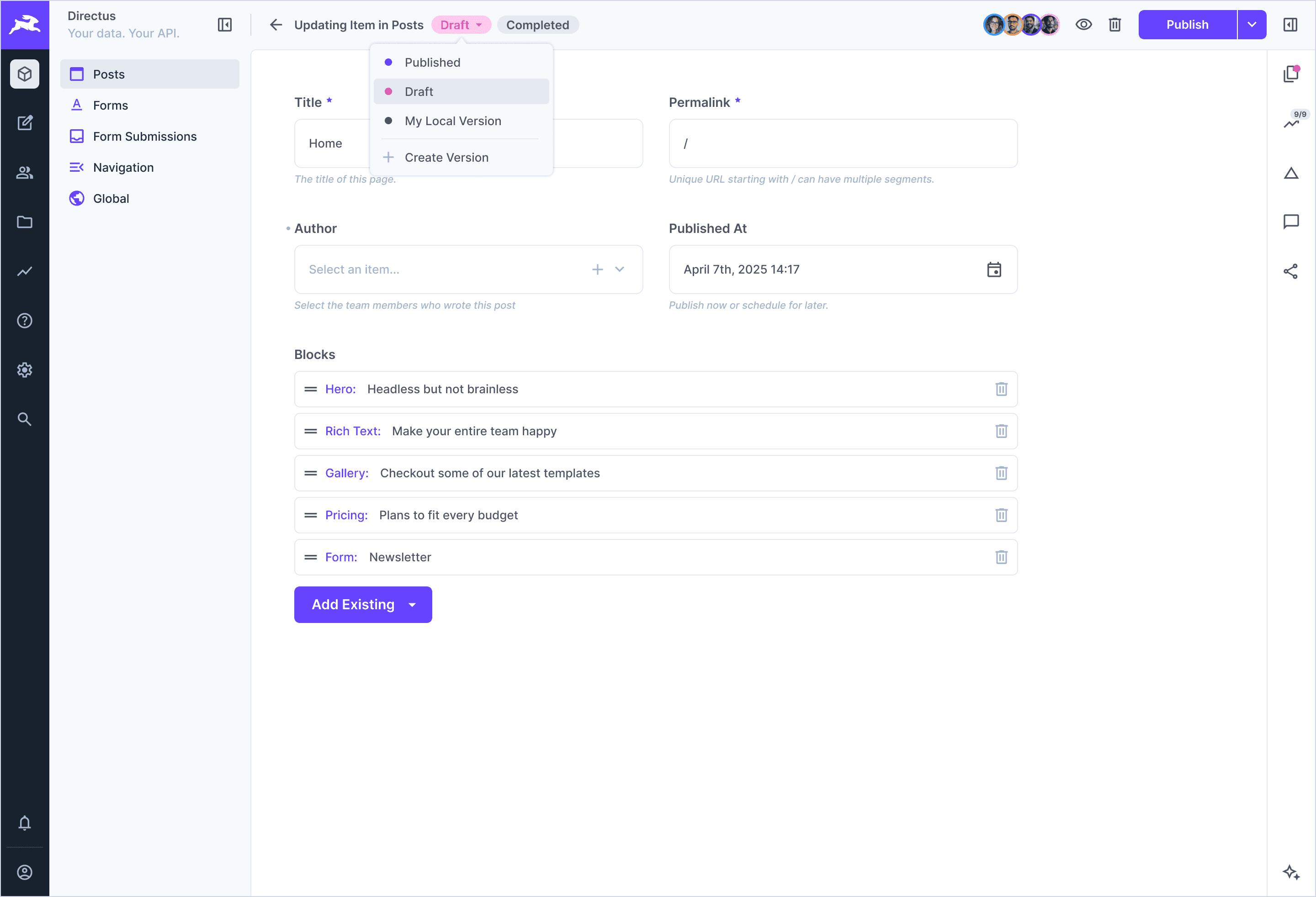
Content teams have been asking for a real editorial workflow inside Directus. When content versioning is enabled, items now have explicit draft and published states. Editors work on drafts by default, and publishing is an intentional action. Version indicators show up across the entire Studio (on item pages, collection views, and visual editor), so there's never ambiguity about which version you're looking at or editing.
New items open in draft mode automatically. This changes the entire feel of content editing in Directus. You're no longer editing a live record and hoping nothing breaks. You're working on a draft, on your own terms, and publishing when it's ready.
This also lays the basis for further improvements, such as scheduled releases and approval workflows that will build on top of this foundation.
AI Translations
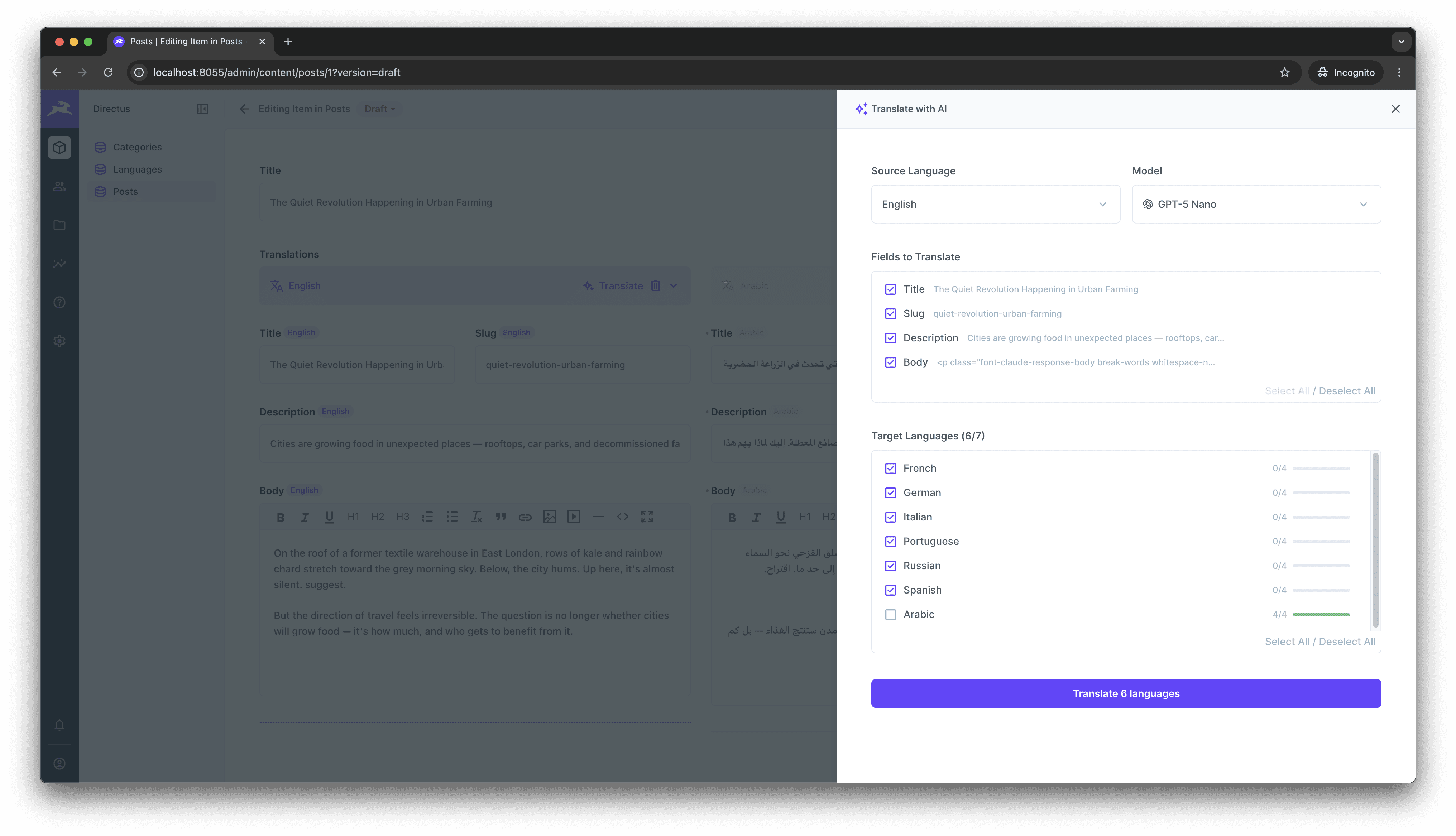
Multilingual content in Directus has always been possible, but the setup required deliberate schema work and a developer who understood the relational model well enough to configure it properly.
Now, you enable translations on a collection and Directus handles the schema scaffolding for you, whether it's a new collection or an existing one. On top of that, AI-assisted translations let teams scale across languages faster without routing every string through a manual process or a third-party TMS. You can customize the model, define a translation glossary, and set up a translation style guide to keep your brand voice consistent across languages.
It's not a replacement for professional human-in-the-loop translation on high-stakes content, but for the volume of content that just needs to be accurate and available, it removes a bottleneck that slows down nearly every multilingual project.
JSON Filtering
This one is for the developers. JSON fields in Directus have always returned the entire blob, which meant developers had to pull everything to the client and parse out what they actually needed. There was no way to query or filter on a specific value within a JSON structure through the API. You either worked around it with custom endpoints, raw SQL, or schema redesigns that split the JSON into relational fields.
Directus now supports dot-notation path queries on JSON fields, with filtering at the database level. You can reference a specific nested value and filter against it directly. No client-side parsing overhead, no workarounds.
This is the kind of improvement that changes how developers feel about building on the platform. When you store structured metadata, form submissions, feature flags, or configuration in JSON fields, which plenty of real-world projects do, you can now query that data effectively.
MCP OAuth 2.1
Directus already supports MCP (Model Context Protocol) for connecting AI agents and tools to your data. But without OAuth, every MCP client needed a static API token. That means no dynamic user identity, no consent flow, no way for third-party AI tools to connect on behalf of actual users with properly scoped permissions.
MCP now supports OAuth 2.1. AI agents can act on behalf of real users, with the existing users’ policies applied, after the user has given their consent. That's a meaningful jump. It's the difference between "we demoed an AI integration" and "our security team approved an AI integration for production."
This removes the biggest blocker for enterprise teams building MCP-connected workflows: the security review. Dynamic client registration, proper consent flows, and user-scoped permissions mean AI workflows get the same governance as everything else in your stack.
Free for Builders, Sustainable at Scale
This release introduces a new licensing model, transitioning from BSL to MSCL (Monospace Sustainable Core License).
Our goal is simple: keep Directus accessible to the vast majority of builders while creating a clear, transparent framework for bigger organizations that get significant value from the platform.
To remove ambiguity and move beyond our old honor system, we are separating our usage policy from the license and introducing software keys. How this works depends on who you are and how you use Directus:
The Open Innovation Grant (Free): Organizations under $5M in revenue and fewer than 50 employees get full access to the platform for free. You'll just need to register to receive your free software key.
Free Core Tier: Larger organizations exploring, prototyping, or building have access to a free Core tier, capped at 3 seats and 50 collections. This tier is available for anyone by default (no key required).
Team & Enterprise Tiers: Organizations operating beyond the thresholds above can unlock advanced features and expand usage limits with add-on flexibility on our paid tiers. These plans require a software key.
If you are an existing customer, you can upgrade to v12 immediately without a software key. Upon upgrading, your instance will enter a 30-day grace period with a prompt to contact us at licensing@directus.io for your key. We'd recommend reaching out before upgrading so you can set the key as an environment variable and skip the grace period entirely. Keys can also be entered through the new Settings > License page inside the Studio.
A Better Studio Experience
The Studio update is comprehensive. The navigation, headers, sidebars, and action patterns have all been reworked to support the new editorial workflows and to make the day-to-day experience clearer for non-technical users.
Draft indicators, version selectors, and publish actions are now core UI elements. The sidebar surfaces content state at a glance. Navigation reflects where you are in the editorial workflow.
For developers, these improvements translate directly into fewer support requests from your team.
Looking Forward
Scheduled releases and approval workflows are next, and they're only possible because this release builds the editorial infrastructure underneath. The Studio will continue to evolve around these workflows.
If you already use Directus and want to enable your team to do more on their own, this version of Directus makes that possible. If you’ve been wondering whether Directus can scale alongside your entire organization, this opens the door for everyone to create, collaborate, and build together.
Ready to move faster?
30 minutes with a product specialist. See how Directus fits your stack.
KEEP EXPLORING
Explore the product context, implementation paths, and more guides from Directus.

